
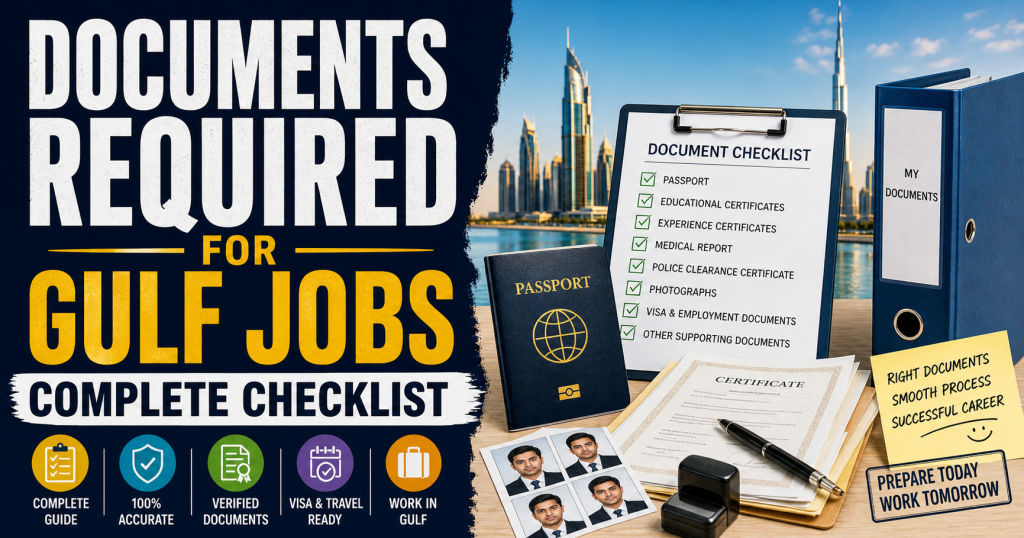
For anyone planning to work in Gulf countries like the UAE, Saudi Arabia, Qatar, Oman, Kuwait, or Bahrain, having the right documents is not just important—it is absolutely essential. Many job seekers lose good opportunities not because they lack skills, but because they are not prepared with the correct documents at the right time.
In the Gulf hiring process, documentation plays a critical role at every stage—from applying for jobs to visa approval and final joining. Employers, immigration authorities, and government systems require accurate, verified, and legally valid documents before allowing you to work.
This complete checklist will guide you through every document required for Gulf jobs in 2026, explained in a simple and practical way so you can prepare without confusion.
Why Proper Documentation Is Critical for Gulf Jobs
Before going into the checklist, it is important to understand why documentation is taken so seriously in Gulf countries. Unlike many local job markets, Gulf employment is tightly regulated by government authorities.
Employers must ensure that:
- The candidate is legally eligible to work
- All qualifications are genuine
- Health and identity are verified
- Immigration rules are followed
Even a small mistake in documentation can lead to:
- Visa rejection
- Job cancellation
- Delays in joining
- Legal complications
Being well-prepared with documents gives you a strong advantage over other candidates.
Basic Personal Documents You Must Have
These are the most fundamental documents required for any Gulf job. Without these, you cannot even start the application process.
Essential personal documents include:
- Valid passport (minimum 6 months validity)
- Passport-size photographs (white background)
- National ID proof (Aadhaar, PAN, etc.)
Your passport is the most important document. Make sure:
- It is not damaged
- All details are correct
- It has enough blank pages
Photographs should follow standard Gulf requirements:
- White background
- Clear face visibility
- No shadows or filters
Educational Certificates and Academic Records
Your educational qualifications play a major role in securing a job, especially for skilled and professional roles.
Required academic documents include:
- SSLC/10th certificate
- Higher secondary/12th certificate
- Degree or diploma certificates
- Mark sheets
For certain jobs, especially professional roles, certificate attestation is required. This means your documents must be verified by authorized government bodies.
Attestation may involve:
- Notary verification
- State-level attestation
- Ministry of External Affairs (MEA)
- Embassy attestation
Without proper attestation, many employers will not accept your qualifications.
Work Experience Certificates
Experience certificates prove your professional background and are essential for most Gulf jobs.
These documents should include:
- Company name and details
- Your job role
- Duration of employment
- Official signature and stamp
If you have worked in multiple companies, collect certificates from all employers.
Additional supporting documents can include:
- Offer letters
- Salary slips
- Relieving letters
These help strengthen your profile and build trust with recruiters.
Professional Certifications and Licenses
Certain jobs in the Gulf require specific certifications or licenses. These can significantly impact your chances of getting hired.
Examples include:
- Safety certifications (like NEBOSH)
- Healthcare licenses (DHA, HAAD, MOH)
- Technical certifications (IT, engineering, etc.)
If your job requires a license, you may need:
- Exam clearance
- Document verification
- Registration with local authorities
Having these certifications ready can speed up your hiring process.
Updated CV and Supporting Documents
Your CV is not just for applying—it is also part of your official documentation.
Make sure your CV:
- Matches your certificates and experience
- Has accurate dates and details
- Includes your current contact information
In addition, you may need:
- Cover letter
- Portfolio (for creative roles)
- Project details (for technical jobs)
Consistency between your CV and documents is very important.
Medical Test Documents
Medical fitness is a mandatory requirement for Gulf jobs. You must undergo medical tests before visa approval.
Typical medical documents include:
- Medical fitness certificate
- Blood test reports
- Chest X-ray report
Tests are usually conducted at authorized medical centers.
Common checks include:
- Infectious diseases
- General health condition
- Physical fitness
Failing the medical test can lead to visa rejection, so it is an important step.
Police Clearance Certificate (PCC)
Many Gulf countries require a Police Clearance Certificate to ensure that the candidate has no criminal background.
The PCC confirms:
- You have no criminal record
- You are eligible for international employment
This document is usually issued by:
- Passport office
- Local police authority
Processing time may vary, so it is better to apply early.
Visa and Immigration Documents
Once you receive a job offer, the visa process begins. This stage requires several important documents.
Key visa-related documents include:
- Work visa copy
- Entry permit
- Employment contract
- Offer letter
These documents are usually arranged by your employer, but you must review them carefully.
Check for:
- Correct name and passport details
- Job role and salary
- Company information
Any mismatch should be corrected immediately.
Additional Documents After Arrival
After reaching the Gulf country, additional documentation is required to complete your employment process.
These may include:
- Residence visa
- Emirates ID or local ID
- Labor card
- Health card
These documents are processed locally and are necessary for legal employment.
Important Checklist Before You Travel
Before leaving your home country, make sure you have all essential documents ready.
Travel checklist:
- Original passport
- Visa copy
- Offer letter
- Educational and experience certificates
- Medical reports
- Passport photos
It is also advisable to carry:
- Multiple photocopies
- Soft copies in your phone or email
Being organized at this stage can prevent last-minute issues.
Common Documentation Mistakes to Avoid
Many candidates face problems due to simple mistakes in documentation. Avoiding these can save time and stress.
Common mistakes include:
- Expired passport
- Mismatch in name or details
- Fake or altered certificates
- Missing attestation
- Poor-quality document scans
Always double-check your documents before submission.
Tips to Keep Your Documents Safe
Managing your documents properly is very important during the Gulf job process.
Useful tips:
- Keep originals in a safe folder
- Maintain digital copies
- Do not share documents with unverified sources
- Label your files clearly
Proper organization helps you respond quickly when documents are requested.
How to Speed Up the Documentation Process
Documentation can sometimes delay your job process. Being prepared in advance can help you move faster.
You can speed up by:
- Keeping all documents ready before applying
- Completing attestation early
- Renewing passport if needed
- Organizing files in advance
Prepared candidates are always preferred by recruiters.
Final Thoughts
Getting a Gulf job is not just about skills—it is also about being fully prepared with the right documents. Documentation is a critical part of the hiring and visa process, and even a small mistake can cause delays or rejection.
The key is to stay organized, ensure accuracy, and prepare everything in advance. When your documents are complete and verified, your chances of getting hired and joining smoothly increase significantly.
Think of your documents as your foundation. The stronger and more organized they are, the easier your Gulf job journey will be. With the right preparation and attention to detail, you can move forward confidently and take the next step toward building a successful career in the Gulf.