
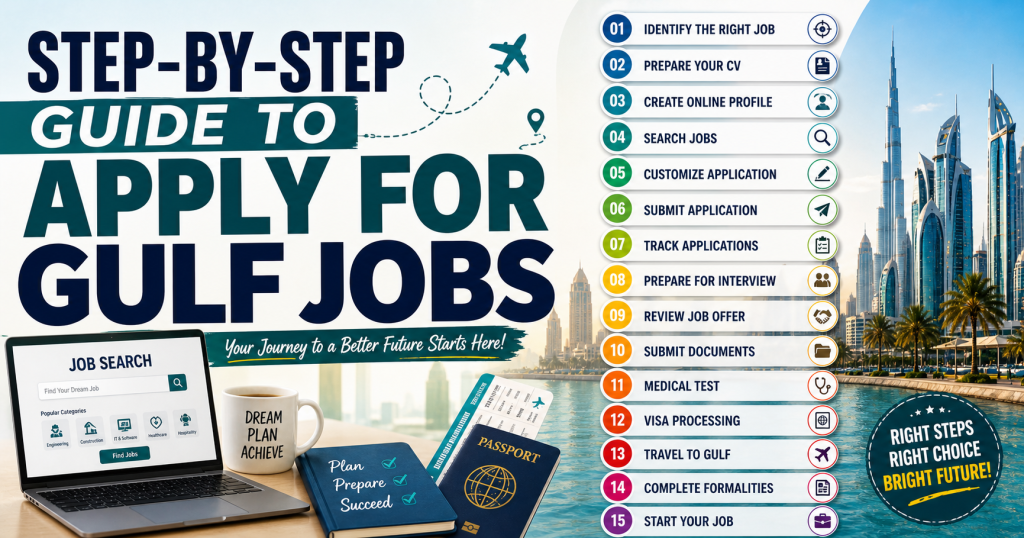
For many job seekers, especially from India, securing a job in Gulf countries like the UAE, Saudi Arabia, Qatar, Oman, Kuwait, and Bahrain is a major life goal. The attraction is clear—tax-free income, better career opportunities, and the ability to support family financially. However, while thousands apply every day, only a limited number succeed. The main reason is not always lack of qualification, but lack of understanding of the correct application process.
Applying for Gulf jobs is not just about sending a CV and waiting for a response. It is a structured process that requires planning, preparation, and smart execution. If you follow the right steps, your chances of success increase significantly. This guide will walk you through each stage in a practical and realistic way so that you can approach your Gulf job search with confidence.
Understanding the Gulf Job Market Before Applying
Before you start applying, it is important to understand how the Gulf job market works. In 2026, recruitment has become more digital and competitive. Companies prefer candidates who are skilled, ready to join quickly, and adaptable to multicultural environments.
Key realities of the Gulf job market include:
- High competition for entry-level jobs
- Preference for candidates with Gulf experience
- Strong demand for certified professionals
- Faster hiring cycles compared to earlier years
Understanding these factors will help you prepare better and avoid unrealistic expectations.
Step 1: Identify the Right Job Role for You
The first step is clarity. Many candidates fail because they apply randomly without focusing on a specific role. You need to identify what job suits your skills, experience, and qualifications.
Ask yourself:
- What is my core skill?
- Which industry do I belong to?
- Do I meet the job requirements?
Instead of applying everywhere, focus on roles where you match at least 70–80% of the requirements. This increases your chances of getting shortlisted.
Step 2: Prepare a Professional Gulf-Standard CV
Your CV is your most important tool. It is the first thing a recruiter sees, and it decides whether you move to the next stage.
A strong CV should include:
- A clear and short professional summary
- Relevant work experience in reverse order
- Key skills related to the job
- Educational qualifications and certifications
- Contact details with current location
Avoid common mistakes such as long paragraphs, unnecessary details, or poor formatting. Keep it clean, simple, and focused. Ideally, your CV should be 1–2 pages.
Step 3: Create a Strong Online Presence
In 2026, many recruiters search for candidates online before contacting them. Having a strong online presence increases your visibility.
Important actions include:
- Creating a professional LinkedIn profile
- Keeping your information updated
- Using a professional profile photo
- Adding relevant skills and experience
This step may seem optional, but it can significantly improve your chances of getting noticed.
Step 4: Search for Genuine Job Opportunities
Finding genuine job opportunities is one of the most important steps. Many candidates waste time on fake or irrelevant job postings.
Safe and effective job search methods include:
- Trusted job portals
- Official company websites
- Verified recruitment agencies
- Professional networking
Avoid applying through unknown WhatsApp messages or unverified sources.
Step 5: Customize Your Application
One of the biggest mistakes job seekers make is sending the same CV for every job. This reduces your chances of success.
Instead, tailor your application for each role by:
- Matching your skills with the job description
- Highlighting relevant experience
- Using keywords from the job posting
Even small changes can make a big difference in how your application is perceived.
Step 6: Submit Applications Properly
Once your CV is ready and customized, the next step is submitting your application.
While applying:
- Use a professional email address
- Write a short and clear message
- Attach your updated CV
- Double-check all details before sending
Many companies use Applicant Tracking Systems (ATS), so make sure your CV is simple and keyword-optimized.
Step 7: Wait and Track Your Applications
After applying, do not just wait passively. You should track your applications and stay organized.
You can:
- Maintain a list of jobs you applied for
- Note the date of application
- Follow up if needed after a few days
This helps you stay in control of your job search and avoid confusion.
Step 8: Prepare for Interviews
If your application is shortlisted, you will be invited for an interview. This is your opportunity to prove your suitability for the role.
Common types of interviews:
- HR interview
- Technical interview
- Final managerial interview
To prepare effectively:
- Research the company
- Understand the job role
- Practice common questions
- Prepare your documents
Confidence and clarity in communication are very important during interviews.
Step 9: Understand the Job Offer Carefully
If you successfully clear the interview, the company will provide a job offer. This is a critical stage where many candidates make mistakes.
Carefully review:
- Salary structure
- Benefits (accommodation, transport, etc.)
- Working hours
- Contract terms
Do not rush to accept. Take time to understand all details and clarify any doubts.
Step 10: Submit Required Documents
After accepting the offer, you will need to submit documents for processing.
Common documents include:
- Passport copy
- Educational certificates
- Experience certificates
- Photographs
Make sure all documents are genuine and clear. Any mismatch or fake document can lead to rejection.
Step 11: Complete Medical Tests
Most Gulf countries require medical fitness tests before issuing a work visa.
Typical tests include:
- Blood test
- Chest X-ray
- General health check
Passing the medical test is mandatory for visa approval.
Step 12: Visa Processing and Approval
Once your documents and medical tests are cleared, your employer will start the visa process.
This includes:
- Work permit approval
- Entry visa issuance
- Immigration clearance
The time required can vary from a few days to a few weeks depending on the country and company.
Step 13: Travel to the Gulf Country
After receiving your visa, you can travel to your destination country.
Before traveling:
- Check your documents
- Confirm your flight details
- Coordinate with your employer
On arrival, your employer may arrange accommodation and initial support.
Step 14: Complete Residence Formalities
After reaching the Gulf, you will need to complete local formalities.
These include:
- Medical test (local)
- Biometric registration
- Residence visa stamping
Once completed, you become a legal employee in that country.
Step 15: Start Your Job and Adapt
The final step is joining your job and starting your new journey. Most companies have a probation period during which your performance is evaluated.
During this phase:
- Learn company policies
- Adapt to the work culture
- Improve your skills
A good start can lead to long-term success.
Common Mistakes to Avoid
Many candidates fail due to simple mistakes. Avoiding these can improve your chances significantly.
Common mistakes include:
- Applying without checking requirements
- Sending poorly formatted CVs
- Falling for fake job offers
- Paying money for jobs
- Not preparing for interviews
Awareness is your best protection.
Tips to Increase Your Success Rate
If you want better results, focus on improving your approach.
Helpful tips:
- Apply consistently but strategically
- Upgrade your skills regularly
- Build professional connections
- Stay updated with job market trends
- Be patient and persistent
Success in Gulf jobs requires effort, but the rewards are worth it.
Summary
Applying for Gulf jobs is a process that requires planning, patience, and smart execution. Many candidates fail not because they lack skills, but because they do not follow the correct steps.
When you understand the process and prepare properly, your chances of success increase significantly. Focus on building a strong profile, applying to the right jobs, and staying alert throughout the process.
The journey may not be easy, but with the right strategy and consistent effort, you can achieve your goal of working in the Gulf and building a better future.