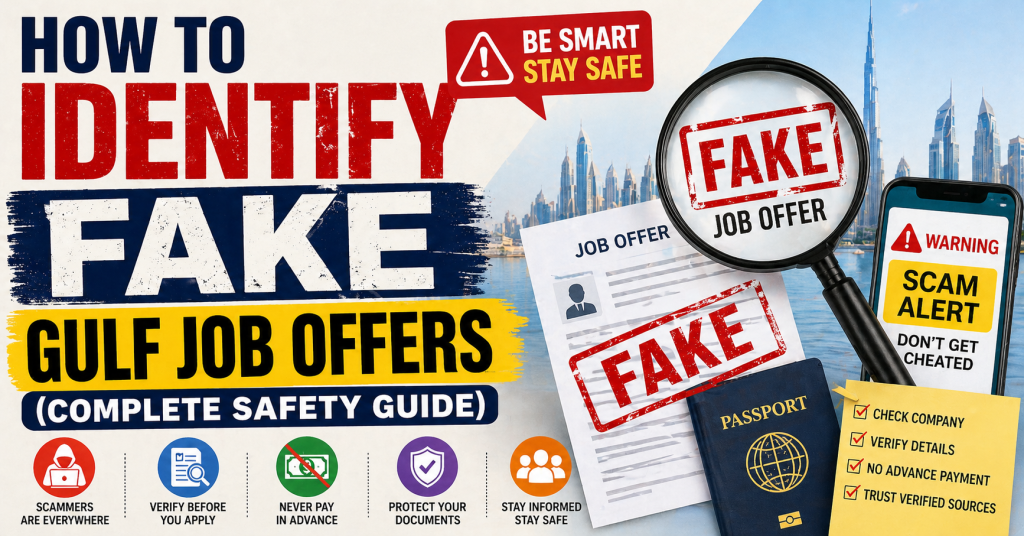
For thousands of job seekers, especially from India, getting a job in Gulf countries like the UAE, Saudi Arabia, Qatar, Oman, and Kuwait is a major life goal. The opportunity to earn tax-free income, support family, and build a stable future attracts candidates from different backgrounds every year. However, along with genuine opportunities, there is also a growing number of fake job offers and recruitment scams targeting innocent job seekers.
Many people lose their hard-earned money, valuable time, and sometimes even their personal documents because they fail to identify fraudulent job offers at the right time. These scams are becoming more sophisticated, making it difficult for even educated candidates to distinguish between real and fake opportunities. This is why understanding how these scams work and how to identify them is extremely important.
This complete safety guide will help you clearly understand the warning signs of fake Gulf job offers, how scammers operate, and what steps you should take to protect yourself.
Understanding Why Gulf Job Scams Are Increasing
The demand for Gulf jobs is very high, and scammers take advantage of this situation. They know that job seekers are often eager and sometimes desperate to secure overseas employment. This emotional factor makes it easier for fraudsters to manipulate candidates.
Scammers create fake job offers that look attractive and convincing. They promise high salaries, free accommodation, visa processing, and quick joining. These offers are designed to create urgency so that candidates act quickly without verifying details.
The main reasons why these scams are increasing include:
- High demand for Gulf jobs
- Lack of awareness among job seekers
- Easy access to communication tools like WhatsApp and email
- Availability of fake documents and websites
Understanding this background will help you stay alert and cautious during your job search.
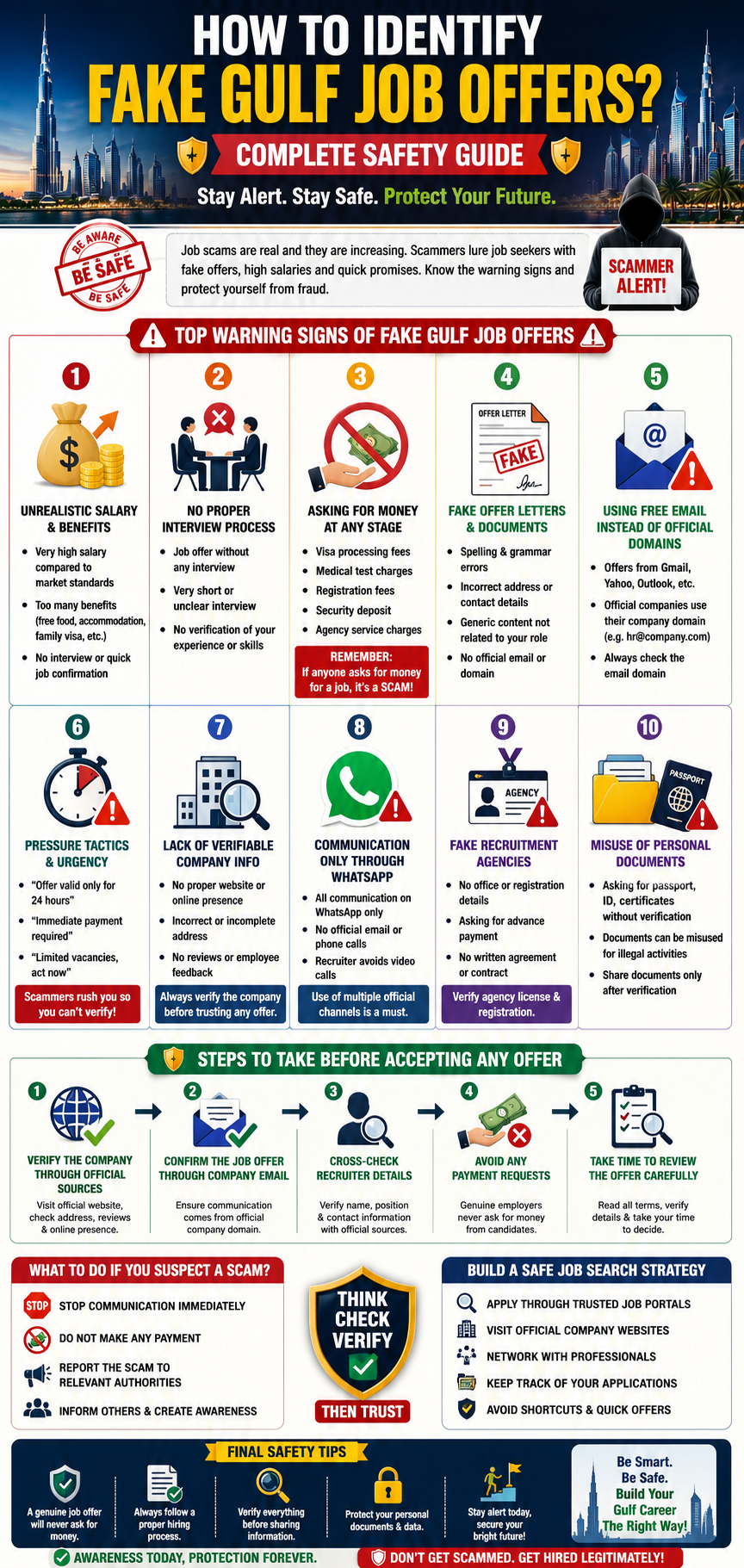
Unrealistic Salary and Benefits Promises
One of the biggest red flags of a fake job offer is an unrealistic salary package. If an offer seems too good to be true, it usually is.
Scammers often attract candidates by offering:
- Very high salary compared to market standards
- Free accommodation, food, transport, and family visa
- No interview or minimal selection process
- Immediate job confirmation
In reality, genuine companies follow a structured hiring process and offer salaries based on your experience and industry standards. When you receive an offer that promises everything with very little effort, you should question its authenticity.
Always compare the offered salary with market rates. If it is significantly higher without any strong justification, it is a warning sign.
No Proper Interview Process
A genuine employer will always conduct a proper interview before hiring a candidate. This may include phone interviews, video interviews, or even multiple rounds depending on the job role.
Fake recruiters often skip this step or conduct very basic interviews just to make it look real. In many cases, candidates receive an offer letter without any interview at all.
Be cautious if:
- You receive a job offer without an interview
- The interview is too short and lacks technical questions
- The recruiter does not verify your experience or qualifications
A real employer will always take time to evaluate your skills before offering a job.
Asking for Money at Any Stage
This is the most common and dangerous sign of a fake job offer. Genuine employers and recruiters do not ask candidates to pay money for getting a job.
Scammers may ask for payment under different names such as:
- Visa processing fees
- Medical test charges
- Registration fees
- Security deposit
- Agency service charges
They may also create urgency by saying that the job offer will be cancelled if payment is not made immediately.
You should remember one simple rule:
If anyone asks for money to give you a job, it is almost certainly a scam.
Always refuse such requests and avoid further communication.
Fake Offer Letters and Documents
Scammers often send professionally designed offer letters that look very convincing. These documents may include company logos, signatures, stamps, and even fake contact details.
However, there are usually small mistakes that can help you identify them.
Look for the following signs:
- Spelling and grammar errors
- Incorrect company address or contact details
- Generic content not related to your role
- No official email ID or domain
Always verify the offer letter by checking the company’s official website and contacting them directly if needed.
Using Free Email Services Instead of Official Domains
Professional companies use official email domains for communication. For example, a company named ABC Group will use an email like hr@abcgroup.com.
Fake recruiters often use free email services such as:
- Gmail
- Yahoo
- Outlook
If you receive a job offer from such email addresses, especially for a reputed company, you should be cautious.
Always check whether the email ID matches the company’s official domain. This is a simple but powerful way to identify fake job offers.
Pressure Tactics and Urgency
Scammers often create a sense of urgency to force candidates into making quick decisions. They may say that the position is limited or that immediate payment is required to secure the job.
Common pressure tactics include:
- “Offer valid only for 24 hours”
- “Immediate payment required to confirm visa”
- “Limited vacancies, act now”
These tactics are used to prevent you from verifying the offer.
A genuine employer will give you reasonable time to review the offer and make a decision. Never rush into any agreement without proper verification.
Lack of Verifiable Company Information
Before accepting any job offer, it is important to verify the company’s existence and credibility.
Fake job offers often come from companies that:
- Do not have a proper website
- Have very limited online presence
- Provide incorrect or incomplete address details
To verify a company:
- Visit their official website
- Check their presence on professional platforms
- Look for reviews or employee feedback
If you cannot find reliable information about the company, it is better to avoid the offer.
Communication Only Through WhatsApp
While WhatsApp is commonly used for communication, relying only on WhatsApp for recruitment is a red flag.
Scammers prefer WhatsApp because it is easy to create fake profiles and avoid traceability.
Be cautious if:
- All communication happens only on WhatsApp
- No official email communication is provided
- The recruiter avoids phone or video calls
A genuine recruitment process usually includes multiple communication channels, including official emails and interviews.
Fake Recruitment Agencies
Some scammers operate under the name of fake recruitment agencies. They may claim to have connections with Gulf companies and promise guaranteed jobs.
Warning signs of fake agencies include:
- No proper office or registration details
- Asking for advance payment
- No written agreement or contract
- Lack of transparency in the process
Before dealing with any agency, verify its registration and reputation. Trusted agencies will always follow proper procedures and provide clear information.
Misuse of Personal Documents
Many candidates unknowingly share sensitive documents such as passport copies, certificates, and ID proofs without proper verification. Scammers can misuse these documents for illegal activities.
To protect yourself:
- Share documents only with verified employers
- Avoid sending documents on WhatsApp without confirmation
- Do not share unnecessary personal information
Always ensure that the organization requesting your documents is genuine.
Steps You Should Take Before Accepting Any Offer
To stay safe, you should follow a systematic approach before accepting any Gulf job offer.
Important steps include:
- Verify the company through official sources
- Confirm the job offer through company email
- Cross-check recruiter details
- Avoid any payment requests
- Take time to review the offer carefully
Being cautious at this stage can save you from serious problems later.
What to Do If You Suspect a Scam
If you come across a suspicious job offer, do not ignore it. Taking the right action can protect not only you but also other job seekers.
You should:
- Stop communication immediately
- Do not make any payment
- Report the scam to relevant authorities
- Inform others to create awareness
Awareness is one of the strongest tools to fight job scams.
Building a Safe Job Search Strategy
The best way to avoid fake job offers is to follow a safe and structured job search approach.
Focus on:
- Applying through trusted job portals
- Visiting official company websites
- Networking with professionals
- Keeping track of your applications
Avoid shortcuts and quick offers that seem too easy. A genuine job process may take time, but it is always safer and more reliable.
Final Thoughts
The dream of working in the Gulf is achievable, but it requires careful planning and awareness. Fake job offers are a serious problem, but they can be avoided if you stay alert and informed.
Most scams follow similar patterns, and once you understand these patterns, it becomes easier to identify them. Always remember that a genuine job offer will never ask for money, will follow a proper hiring process, and will provide clear and verifiable information.
Take your time, do proper research, and never rush into decisions. Your safety and career are more important than any quick opportunity.
By following the guidelines in this article, you can protect yourself from fraud and move confidently towards securing a genuine job in the Gulf.